Sewer Line Inspection Ontario: Should Buyers Get a Sewer Scope?

Sewer Line Inspections in Ontario: Should You Get a Sewer Scope Before Buying a Home?
What Is a Sewer Scope?
A sewer scope—also commonly called a sewer camera inspection—uses specialized camera equipment to inspect the inside of an accessible sewer line.
Depending on the property and access available, a qualified professional may be able to evaluate portions of the line for visible conditions such as:
Blockages.
Root intrusion.
Cracks.
Deterioration.
Displacement.
Low areas or other drainage concerns.
Obstructions.
Pipe material and visible condition.
The purpose isn't to predict exactly how long a sewer will last.
It's to obtain information about something you otherwise largely cannot see before buying the property.
Why Doesn't a Regular Home Inspection Tell Me This?
A traditional home inspection is primarily a visual inspection of accessible components.
Your inspector can look at:
Plumbing fixtures.
Visible supply piping.
Visible drainage.
Basement plumbing.
Signs of leakage.
Water flow and drainage.
But the sewer line running underground from the house toward the municipal system isn't generally visible during an ordinary inspection.
That's why:
A GOOD HOME INSPECTION AND A SEWER SCOPE ARE NOT THE SAME THING.
One doesn't necessarily replace the other.

Who Owns the Sewer Line?
This is where buyers need to be careful because responsibility can depend on the municipality and infrastructure involved.
Using Toronto as a clear Ontario example, the underground sewer service connection is divided into a City-side and private-side, with the property line forming the division. Toronto states that the private-side sewer service line is the property owner's responsibility.
That means a problem with underground infrastructure isn't automatically:
“The City's problem.”
And buyers shouldn't assume that responsibility works identically in every Ontario municipality.
VERIFY THE PROPERTY AND THE MUNICIPALITY.
Why Are Sewer Lines Important in Older Homes?
The house may have undergone:
New kitchen.
New bathrooms.
New flooring.
New windows.
New furnace.
New electrical.
But what happened to:
THE ORIGINAL UNDERGROUND DRAINAGE INFRASTRUCTURE?
That's an important question.
Depending on:
Property age.
Pipe material.
Soil conditions.
Previous repairs.
Mature landscaping.
Installation.
Renovations.
Property history,
the sewer lateral may deserve additional investigation.
Older Home Doesn't Automatically Mean Bad Sewer
This follows the philosophy of this entire series.
OLD DOESN'T AUTOMATICALLY MEAN FAILED.
An older sewer line may still be functioning.
A newer sewer line can still have a problem.
The age of the home is:
A REASON TO ASK QUESTIONS—not proof that something is wrong.
What Can a Sewer Camera Potentially Find?
Depending on accessibility and conditions, a sewer inspection may identify visible evidence of:
Tree-root intrusion.
Cracking.
Broken sections.
Displaced joints.
Deteriorated pipe.
Obstructions.
Debris.
Low areas.
Previous repairs.
Changes in pipe material.
Other conditions requiring further investigation.
But remember:
A CAMERA INSPECTION IS INFORMATION—not a guarantee against every future sewer problem.
Tree Roots and Sewer Lines
This is one reason sewer inspections can be particularly relevant in:
Mature neighbourhoods.
Those beautiful streets lined with:
🌳 Mature trees
are often exactly what buyers love about established communities.
But underground:
Roots naturally seek moisture.
If a sewer line has vulnerable joints, cracks or openings, roots may potentially enter.
That doesn't mean:
“Mature trees = sewer problems.”
It means mature landscaping can be one factor when deciding whether further sewer investigation makes sense.

But have you checked what's happening underground?
What Are Signs of a Potential Sewer Problem?
Possible warning signs can include:
Slow drainage.
Repeated drain backups.
Gurgling.
Sewer odours.
Previous basement backups.
Multiple fixtures draining poorly.
Known previous sewer repairs.
Mature trees near the service route.
But:
NO SYMPTOMS DOESN'T NECESSARILY PROVE THE UNDERGROUND PIPE IS PERFECT.
And one slow sink doesn't automatically mean:
Broken sewer.
Let the appropriate professional diagnose the issue.
Ask About Previous Sewer Backups
This can be a very useful due-diligence question.
Ask whether there is known history of:
Sewer backups.
Drain problems.
Excavation.
Pipe replacement.
Root clearing.
Backwater valve installation.
Waterproofing.
Basement flooding.
Insurance claims where appropriately disclosed/available.
Then investigate the information further if it matters to the buyer.
Sewer Backup and Water Infiltration Aren't Necessarily the Same Thing
A wet basement can have many possible causes.
For example:
Foundation leakage.
Surface drainage.
Plumbing leak.
Sewer backup.
Sump issues.
Other water entry.
So:
“THE BASEMENT FLOODED” ISN'T A COMPLETE DIAGNOSIS.
Ask:
WHERE DID THE WATER COME FROM?
That distinction can completely change the investigation.
What Is a Sewer Lateral?
In simple terms, the sewer lateral/service line connects the property's plumbing to the larger sewer system.
It is easy for buyers to forget about because:
They can't see it.
But portions of this infrastructure may fall within the homeowner's responsibility depending on the municipality.
For example, Toronto identifies a City-side and private-side sewer service line and says the private-side is the property owner's responsibility.
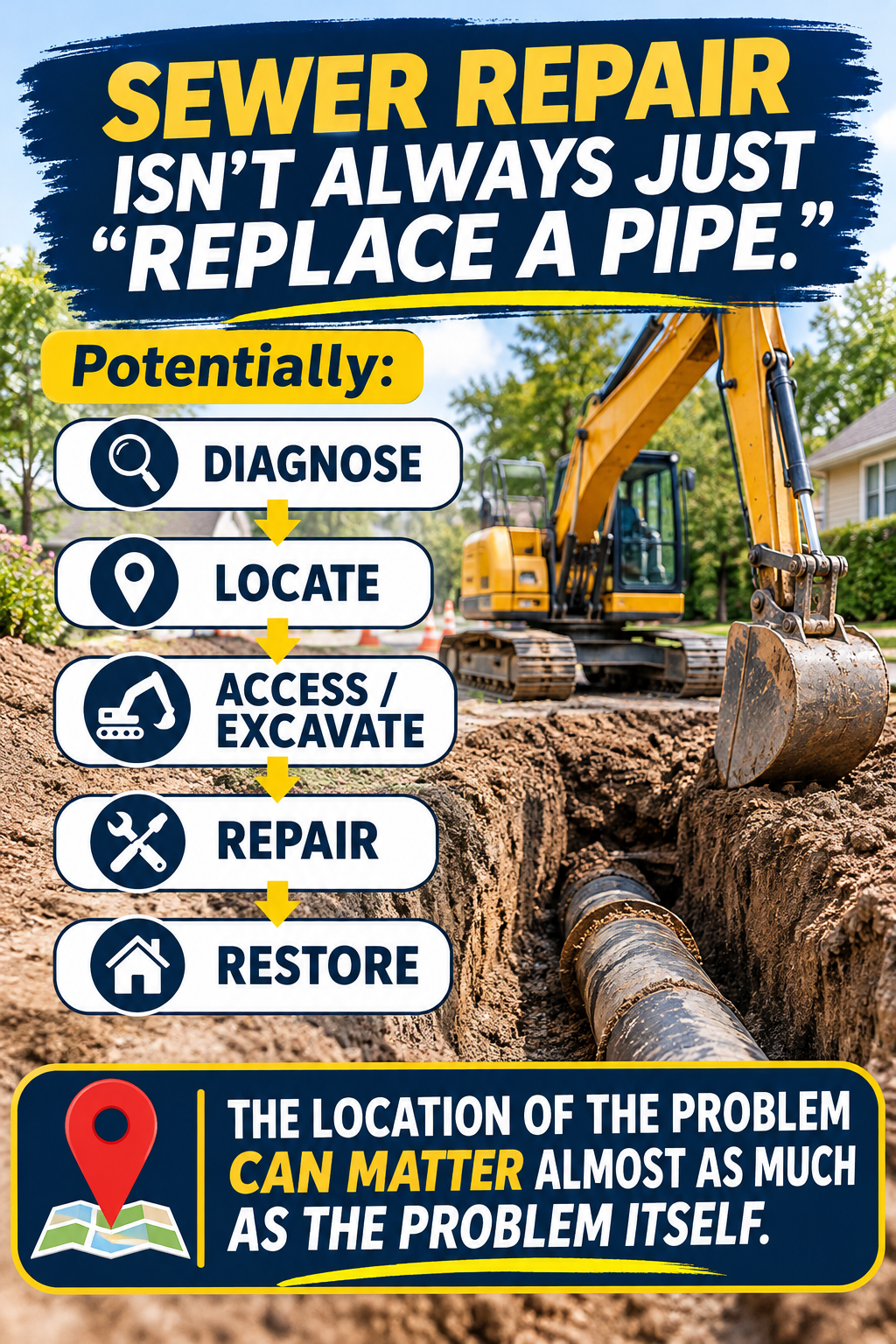
Why Can Sewer Repairs Become Expensive?
Because the problem may be:
UNDERGROUND.
Repair can potentially involve:
Locating the issue.
Excavation.
Plumbing work.
Pipe replacement.
Landscaping disruption.
Driveway or walkway disruption.
Restoration.
Permits/municipal coordination where applicable.
And the specific repair method will depend on:
Location.
Depth.
Pipe condition.
Accessibility.
Municipality.
Property.
How Much Does Sewer Line Replacement Cost in Ontario?
There isn't one responsible universal number.
Cost can vary substantially based on:
Length.
Depth.
Pipe material.
Location.
Excavation requirements.
Landscaping.
Driveways.
Sidewalks.
Access.
Repair method.
Municipality.
Contractor.
So I would not advise a buyer to make a purchase decision based on:
“Google says sewer replacement costs $X.”
Instead:
IDENTIFY THE PROBLEM → DETERMINE RESPONSIBILITY → OBTAIN A PROPERTY-SPECIFIC QUOTE.
Should Every Buyer Get a Sewer Scope?
Not necessarily.
There isn't a universal rule that:
Every house needs one.
But I would consider discussing it more seriously where there are factors such as:
Older property.
Mature trees.
Previous sewer issues.
Drainage symptoms.
Unknown sewer history.
Inspector recommendation.
Evidence of previous excavation.
Buyer planning major renovations.
Buyer simply wants additional information about an inaccessible system.
The decision should be:
PROPERTY-SPECIFIC.
When Should the Sewer Scope Be Done?
Ideally:
WHILE YOU STILL HAVE THE CONTRACTUAL ABILITY TO INVESTIGATE THE PROPERTY.
If you're purchasing with an inspection/due-diligence condition and a sewer inspection matters to your decision:
Plan accordingly.
Don't wait until:
The night before the condition expires
to start looking for a contractor.
What If the Camera Finds Something?
Don't panic.
First determine:
What exactly was observed?
Where is it?
How significant is it?
Is the pipe functioning?
Is maintenance recommended?
Is repair recommended?
Is replacement recommended?
Who is responsible?
What does it cost?
How urgent is it?
Then:
MAKE THE REAL ESTATE DECISION.
A Sewer Finding Doesn't Automatically Mean “Walk Away”
Suppose a sewer scope identifies an issue.
That doesn't automatically mean:
Bad house.
It means:
New information.
Now the buyer can investigate:
Severity.
Cost.
Responsibility.
Timing.
Negotiation options.
Overall property value.
Then decide whether the property still makes sense.
THE PURPOSE OF DUE DILIGENCE ISN'T TO FIND A PERFECT HOUSE.
IT'S TO UNDERSTAND THE HOUSE YOU'RE BUYING.
What If the Seller Says “We've Never Had a Problem”?
That's useful information.
But it doesn't necessarily tell you:
Current pipe condition.
Remaining useful life.
Whether roots are beginning to enter.
Whether previous owners experienced issues.
Whether portions were repaired.
The seller's experience is:
One piece of information.
Not necessarily a substitute for professional investigation.
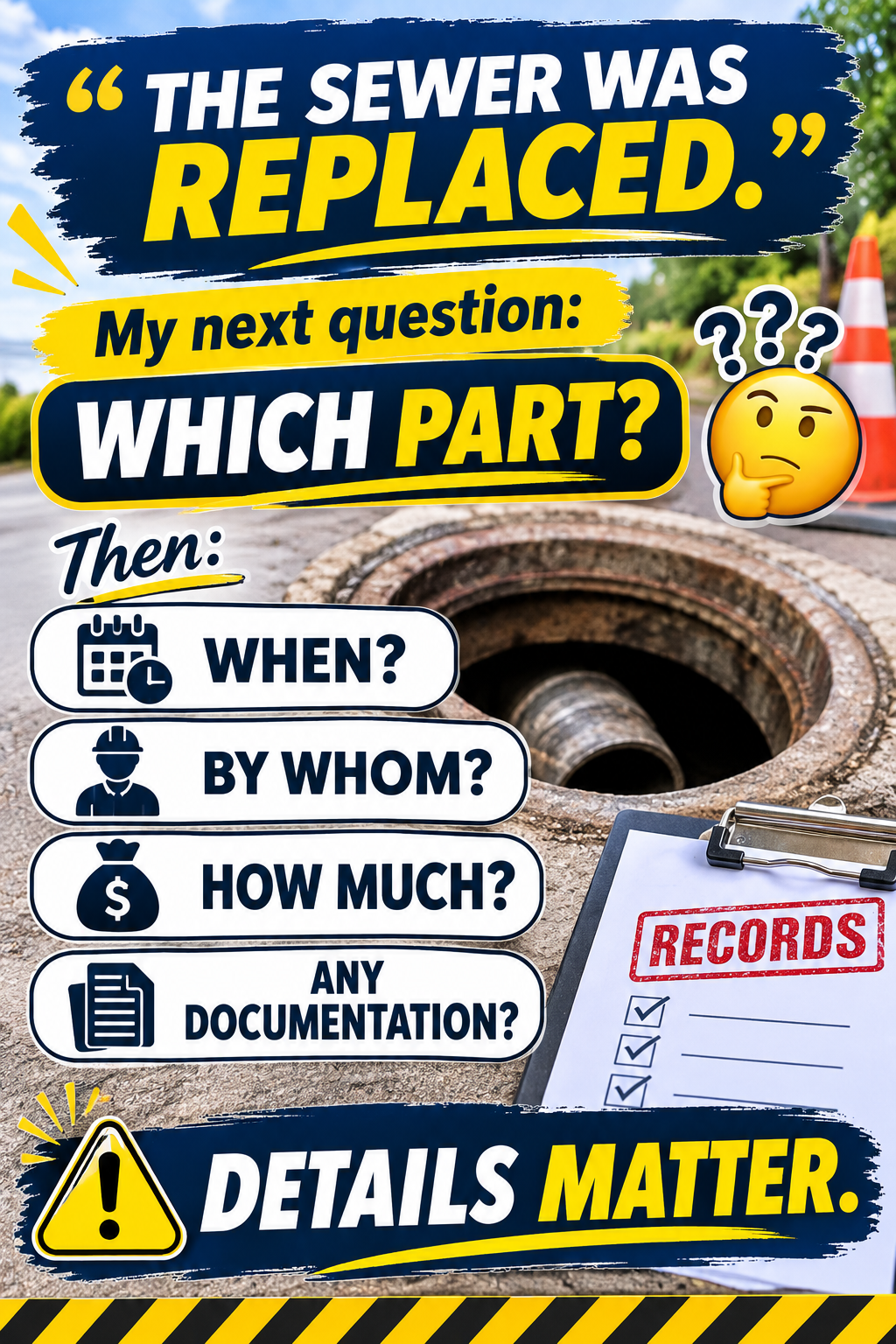
What If the Sewer Was Replaced?
Great.
Ask:
WHAT WAS REPLACED?
Was it:
A small section?
The entire private lateral?
Interior drainage?
Exterior sewer?
A repair?
Complete replacement?
Then:
IS THERE DOCUMENTATION?
Look for available:
Invoices.
Contractor information.
Permits where applicable.
Municipal records where available.
Scope of work.
What About a Backwater Valve?
A backwater valve is intended to help protect against certain sewer-backup conditions by preventing reverse flow into the home.
But:
BACKWATER VALVE ≠ PERFECT SEWER LINE.
Its presence doesn't tell you:
Condition of the entire lateral.
Pipe material.
Whether roots exist.
Whether sections are damaged.
Whether other drainage problems exist.
Treat it as one component of the property's plumbing/drainage system.
What About Basement Waterproofing?
Same principle.
A seller may say:
“The basement was waterproofed.”
Ask:
Interior or exterior?
What problem was being addressed?
When?
Which walls?
Drainage system?
Warranty?
Documentation?
Because:
WATERPROOFING AND SEWER REPAIR ARE NOT THE SAME THING.
Buying a Century Home?
A sewer scope can become one part of a broader older-home investigation.
For a century property, we may already be considering:
Electrical.
Plumbing.
Foundation.
Asbestos.
Roof.
Insulation.
Water.
Renovations.
Permits.
Sewer.
That's why our master philosophy remains:
DON'T FEAR THE AGE. UNDERSTAND THE HOUSE.
READ: Buying an Older Home in Ontario →
Sewer Line vs. Plumbing Inspection
Another important distinction:
Plumbing inside the house
isn't the same thing as:
Underground sewer service outside the house.
A home may have:
Beautiful new bathrooms.
New supply lines.
New fixtures.
while still having:
Older underground drainage infrastructure.
NEW BATHROOM ≠ NEW SEWER.
What About Rural Properties?
Important distinction.
Not every Ontario property connects to a conventional municipal sanitary sewer.
Some properties may involve:
Septic systems.
Private sewage systems.
Other drainage infrastructure.
Those require different due diligence.
Ontario also has a separate statutory framework for certain municipal drains, particularly in rural/agricultural areas. The province specifically recommends investigating how a municipal drain may affect a property before purchase because costs and property impacts can follow the land.
SEWER ≠ SEPTIC ≠ MUNICIPAL DRAIN.
They should not be treated as interchangeable.
Buying a Home With a Known Sewer Problem
Now we move from:
Inspection
to:
Real-estate strategy.
Determine:
Problem.
Location.
Responsibility.
Recommended solution.
Cost.
Timing.
Impact on use.
Then consider the transaction.
Possible outcomes might include:
Buyer accepts it.
Further investigation.
Seller agrees to specific work.
Price adjustment.
Other negotiated solution.
Buyer elects not to proceed where permitted by the agreement.
There is no universal answer.
Don't Negotiate Before You Know the Problem
This is important.
Don't receive a sewer report and immediately demand:
“$25,000 OFF.”
without understanding the issue.
Instead:
INSPECT → DIAGNOSE → SCOPE → QUOTE → NEGOTIATE.
That's much stronger buyer representation.

Selling an Older Home?
Sellers should also consider whether known sewer information can be gathered before listing.
If you know there has been:
Previous backup.
Sewer repair.
Pipe replacement.
Excavation.
Backwater valve installation.
Drainage work.
Gather available documentation.
The more clearly we can understand the property's history:
THE BETTER WE CAN PREPARE FOR BUYER DUE DILIGENCE.
The Ana Bastas Sewer Due-Diligence Framework
When sewer concerns arise:
1. PROPERTY
Age + neighbourhood + infrastructure.
↓
2. HISTORY
Any previous backups or repairs?
↓
3. ACCESS
Can the sewer be appropriately inspected?
↓
4. CAMERA
Professional sewer-scope investigation where appropriate.
↓
5. FINDINGS
What was actually observed?
↓
6. LOCATION
Where is the issue?
↓
7. RESPONSIBILITY
Homeowner? Municipality? Other arrangement?
↓
8. SCOPE
Maintenance, repair or replacement?
↓
9. COST
Obtain property-specific information.
↓
10. TRANSACTION
Accept, investigate, negotiate or reconsider.
↓
11. DECISION
DON'T BE AFRAID OF WHAT'S UNDERGROUND. BE AFRAID OF BUYING WITHOUT UNDERSTANDING IT.
Sewer Scope Buyer Checklist
PROPERTY
☐ Age of home considered
☐ Mature trees considered
☐ Sewer history requested
☐ Previous backups investigated
☐ Previous repairs investigated
INSPECTION
☐ Sewer scope considered
☐ Appropriate access available
☐ Qualified professional engaged
☐ Video/report obtained where provided
☐ Findings explained
FINDINGS
☐ Pipe material discussed
☐ Root intrusion?
☐ Cracks/damage?
☐ Displacement?
☐ Obstruction?
☐ Previous repairs?
☐ Further investigation required?
RESPONSIBILITY
☐ Location of issue established
☐ Municipality contacted where appropriate
☐ Private-side responsibility investigated
☐ Municipal-side responsibility investigated
FINANCIAL
☐ Recommended work determined
☐ Quote obtained where appropriate
☐ Excavation considered
☐ Landscaping/driveway restoration considered
☐ Timing/urgency understood
TRANSACTION
☐ Buyer understands findings
☐ Negotiation strategy considered
☐ Insurance implications discussed if applicable
☐ Buyer comfortable proceeding
Frequently Asked Questions
What is a sewer scope?
A sewer scope uses specialized camera equipment to inspect accessible portions of a sewer line and identify visible conditions that may warrant maintenance, repair or further investigation.
Should I get a sewer inspection before buying a house in Ontario?
Not every property necessarily requires one, but it may be worth considering for older homes, properties with mature trees, previous sewer issues, drainage symptoms or when recommended by a professional.
Does a normal home inspection include a sewer camera?
A standard home inspection generally doesn't provide the same interior-camera examination of an underground sewer lateral. Buyers should confirm exactly what services their inspector provides.
How much does a sewer scope cost in Ontario?
Pricing varies by provider, location, property and scope. Obtain a quote from the professional performing the inspection rather than relying on a generic province-wide estimate.
Who is responsible for the sewer line in Ontario?
Responsibility depends on the location of the problem and applicable municipal infrastructure/rules. For example, Toronto distinguishes between City-side and private-side sewer service lines and states that the private-side is the property owner's responsibility.
Can tree roots damage sewer lines?
Roots can enter vulnerable openings, joints or damaged portions of underground piping. Mature trees alone, however, do not prove that a sewer problem exists.
Does a sewer scope guarantee there won't be future problems?
No. It provides information about accessible and visible conditions at the time of inspection; it isn't a guarantee against future failure.
What if the sewer camera finds roots?
The significance depends on the extent, pipe condition and professional assessment. Determine what maintenance or repair is recommended before deciding what the finding means financially.
Does a backwater valve mean the sewer line is good?
No. A backwater valve serves a particular purpose and doesn't establish the condition of the entire underground sewer lateral.
If the basement has never flooded, do I still need a sewer scope?
Lack of flooding is useful history but doesn't necessarily establish the condition of an underground pipe. Whether additional inspection is worthwhile depends on the property and buyer's due-diligence objectives.
Is sewer replacement always expensive?
Cost varies considerably depending on location, depth, access, repair method and restoration requirements. Get a property-specific assessment and quote.
Should I walk away if the sewer scope finds a problem?
Not automatically. First understand the problem, responsibility, recommended solution and cost. Then evaluate it within the overall purchase.
Categories
- All Blogs (1383)
- Ana Bastas Real Estate Team (1)
- Ana Bastas Realtor (1)
- Ana bastas Realty (1)
- Brampton (2)
- Burlington (10)
- Buy & Travel™ Program (12)
- Buyer (343)
- Community News (2)
- Divorce (21)
- Downsizing (20)
- Events (73)
- First Time Home Buyers (156)
- Georgetown (38)
- Georgetown Buyers (8)
- Halton Hills (273)
- Hamilton (26)
- Holidays (18)
- How To (138)
- Interest Rates (11)
- Investor (49)
- Join ABR Team (2)
- Landlord (105)
- Lifestyle (178)
- Milton (84)
- Mississauga (3)
- Mortgage (23)
- Niagara (39)
- Oakville (6)
- Real Estate News (235)
- Realtor (66)
- Renter (100)
- Seller (264)
- Tax's (28)
- Tips (41)
- Toronto (149)
- Wealth Building (14)
- Wellington (3)
- YYZ (107)
Recent Posts





"My job is to find and attract mastery-based agents to the office, protect the culture, and make sure everyone is happy! "